Thursday, May 2, 2013

Orca Update 35


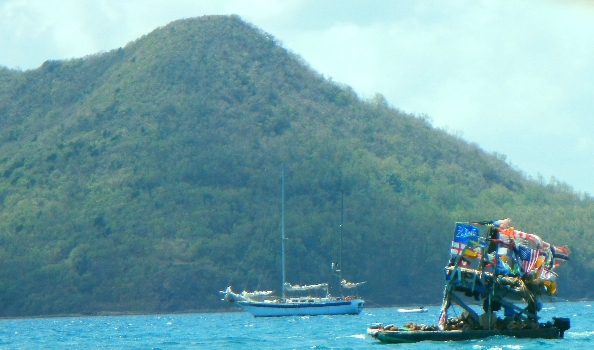
Kestrel overlooking a BVI anchorage
Hello friends, 
Our time in the Caribbean is nearly finished, and we still haven't recovered from the culture shock. We arrived in St Lucia to find hundreds of boats anchored in Rodney Bay. We took a spot in the marina for a night and were perturbed to find the smallest berths—and smallest prices—available were for 50-foot catamarans; when we slid Orca in there was still room for a half-dozen more 30 footers. After clearing with customs, immigration, the port captain, and extracting ourselves from the clutches of the very persistent street merchants, we moved into the bay. Kara was anxious to stretch her legs ashore, but the first two beaches we attempted to land on were staffed by security guards who came running to demand money. Our third attempt was successful, but only because we promised to stay below the tide line. Kara got her first walk ashore--after 27 days at sea--knee deep in the shore-break.


Coconut makes a beer run
The second thing we did in St Lucia was find internet for news from home. We were excited to digest all of our mail, but nestled in amongst the well wishes was a bombshell: along with Kara's sister, her father—none other than the revered Pastor Johnny himself—was dropping into St Lucia for a surprise visit between sermons. And yes, he would be staying aboard, in Orca's five-star luxury accommodation. My first thought was: where am I going to hide 10 gallons of booze? Kara's first thought: thank God we finally fixed the toilet.

We were a few minutes late meeting them at the airport. Pastor Johnny, brandishing a stack of chocolate bars, was battling to hold off a platoon of aggressive taxi drivers. Robyn remained unmolested; fresh from a long sunless winter in foggy Humboldt, she had cunningly camouflaged herself by remaining motionless against a white sheet-rock wall. The taxi drivers slunk away when Kara told them we knew about their dirty little secret: St Lucia's inexpensive bus system.
We quickly realized that, with resort security keeping us off the beaches, the boat was very crowded. Our collective sanity would require a whole lot of snorkeling. The unfortunate side effect was that, by day two, our guests were sporting severe--possibly terminal—sunburns. This affliction in turn required vigorous application of cold beer and margaritas—strictly for medicinal purposes. After a week, we put our guests on a plane in a blizzard of skin cells and Orca set sail for the next rendezvous.

Keeping pace with the parents
Months ago, in a uncharacteristically daring show of bravado, my parents reserved a 36-foot sailboat in the British Virgin Islands. Their lack of experience was causing a spike in parental anxiety as the charter date approached, so Orca arrived a day early and found a lovely anchorage within spitting distance of the charter dock. 
We loaded Tim and Ann onto their boat and Kara skippered them over to Peter Island. We installed them next to Orca, where I imagined they would relax for the remainder of their trip—but the parents had other ideas. Nearing 60, they seemed to have more energy than most 3 year olds; swimming five times daily, snorkeling morning and evening, hiking miles up hot dusty roads, and sailing for hours—often slamming relentlessly to windward—each day. They "did" the BVI in a flurry of activity that left the Orca crew listless and exhausted in their wake. At the end of their visit, they sashayed through customs and sprang lightly onto the ferry, putting in a solid 30 travel-hours to arrive home at 3 A.M, in time for a cup of coffee and a surf before beginning the 8-hour workday. We slept for three days.
Third snorkel of the day

Recuperation was slow process, but eventually we felt strong enough to set sail toward the Panama Canal. We gave the hostile Venezuelan shoreline a wide berth. Skirting the Colombian coastline we were twice overflown by unlit propeller planes at mast height—either drug runners or anti-drug patrols—before we reached Panamanian waters after 1,100 miles.

Panama has a monopoly on canals. On arrival, the Port Captain wanted $200. Immigration wanted another $220. We waited five days (at $50/day) in the marina for the Panama Canal Authority to send someone to verify that our thirty foot boat was, in fact, less than fifty feet long—for a fee, of course. Another $1,000 reserved us a spot in the locks, but we're required to have at least six people aboard. Bodies are available for hire--for a hefty fee, of course.

Transiting the Canal takes two days. On day one, a group of sailboats uses the three Gatun locks to climb nearly 100 feet from the Atlantic to an artificial lake. After spending the night, we will use the four Miraflores locks to descend into the Pacific. Each lock is a thousand feet long, a hundred wide, and are primarily designed for freighters. When they are flooded, the turbulence and wash generated by the enormous volume of injected water is said to be the greatest single danger to a small boat. To lift Orca up to Lake Gatun and lower her into the Pacific will require the release of over fifty million gallons of lake water. 

Orca is roughly scheduled to lock up to the lake on Friday, May 3 at about 1500 and lock down into the Pacific at about 1000 California time the following day. You can watch our transit live at http://www.pancanal.com/eng/photo/camera-java.html. On arrival in the Pacific, it is customary to toast the 30,000 men who lost their lives in the construction of the Panama Canal.

Thanks again,

John & Kara


Saturday, March 9, 2013


Hello from the Caribbean!
We were leaving Cape Town. After a day of departure paperwork involving only five visits to officials in distant corners of the city, we were permitted to depart. The weather forecast looked excellent as we sailed out in a benign Cape Doctor zephyr; just 38 knots on the anemometer—calm compared with the usual 50 or 60. The weather was slow to warm with the frigid north-flowing Benguela current keeping pace beneath us. Ten days out of Cape Town, the first flying fish began to crash into the cabin and we shed our jackets. As we crossed the Prime Meridian, the wind settled to ten knots from the ESE, where it stayed for the next four weeks. Feeling strong, we blew by Saint Helena, a spire of volcanic stone in the middle of the South Atlantic made famous as the place of Napoleon's exile in the late 1800's.

black triggerfish on Ascension
Four weeks out of Cape Town, Ascension Island appeard on the horizon. Despite the lofty name, the island is more of the desolate-pile-of-rubble variety. A small USAF base maintains an airstrip for refueling fighter jets on trans-Atlantic missions and serves double-duty as emergency landing for troubled commercial airliners. The millitary also runs a desailinization plant to generate fresh water for the soldiers, which we had hopes of sharing. After nearly a month at sea, we had used 27 gallons of water, exactly half our supply. Even so, before leaving Cape Town, we'd contacted the authorities on the island asking permission to stop for 30 gallons of fresh water. We submitted our information for the required background checks and were eventually given the green light. We would be allowed up to three days on the island but only between 8 am and 9 pm each day.
We anchored in the dubious protection of the tiny island, next to a floating pipeline for transfering jet fuel ashore. Big eight foot swells rose under the boat and crashed onto the jagged lava coast. Orca rolled mightily. We'd only been settled for a few minutes when we discovered that A.I has, essentially, a one-species ecosystem. The situation is natural and was recorded in journals by square-riggers hundreds of years ago. Regardless, Orca was quickly, entirely, surrounded by a sea of six-to-eight inch triggerfish—only the black variety. We launched the dingy and began the long trek ashore. Rowing through the triggerfish was like rowing through watery soup.
Not sure what would happen if you got tangled up in this big guy...
A beach landing was obviously out of the question; the shorebreak was a raging caldron of sandy spume. The only jetty on the island was a twenty-five foot high brick of concrete poured onto a shelf of black lava. We left the dingy on a string of dilapidated local skiffs tied like Christmas lights to a line anchored about 30-feet off the jetty. After swimming to the pier, a timely surge allows a desperate grab at a knotted rope hanging down the concrete face and slippery climb to a staircase. Once ashore, we were confronted not with the high-security military situation we expected, but with a cadre of dock-workers lounging in the shade of a gutted bunker drinking beer at 10 am on a Monday morning. They offered us a beer but we declined, conserving our wits for a possible millitiary interrogation. We reported our presence to the local authorites—a cherub faced officer who was delighted to see fresh faces and sincerely apologetic about the port, immigration, light, and water fees we were going to have to pay for even our short stop. He was a fount of island information and was so excited that it was impossible to be angry.

black triggerfish following the dingy
We followed his advice and watched the sunset from the beach that evening. As the sun flashed green at the horizon, a dozen giant green sea turtles began to climb laboriously from the ocean. Keeping very still, we let the 550 lb behemoths climb around us to dig their egg holes. They left tracks in the sand like 8-foot wide tractor tires and, stumbling back in the dark, Kara nearly dissapeard into a nest hole. The next morining began early with a startling banging on the hull. I thought perhaps we'd come adrift and Orca was on the lava but investigation revealed 1,200 pounds of oblivious mating sea turtle, their shells bumping the hull. The turtles were friendly and curious, hovering around the boat most of the day. They added a new thrill to snorkeling; they preferred to inspect swimmers at about a six inch distance. We would have prefered ten feet or more.
As we left Ascension Island, I did some mental math; I just couldn't help myself. All told, we had payed almost $3-a-gallon for fresh water. Kara reminded me that, during the next 3,200 miles of sailing into the remotest parts of the Atlantic's watery desert, we might find ourselves willing to pay many times that. We decided to cut Kara's luxurious hair off to save water on the this long passage; we estimated we could save up to 250ml per shower this way.
smooth sailing in the South Atlantic
We quickly picked up the 10-knot SE trades again, and ticked off the next thousand miles to the equator. 900 miles west of Nigeria and the Ivory Coast, we left Africa's newest pirate problems well to starboard. In the center of nowhere, flashing schools of mahi mahi rode the bow wave for hundreds of miles, catching the flying fish Orca spooked. We dried salted tuna strips from the rigging. Eventually, all of our fishing lures were destroyed, the hooks all straightened, the plastics and wood all mangled, the reels all spooled. A blue marlin the size of a canoe followed us for hours. We sailed through zooplankton blooms that tinted the ocean a cloudy salmon color. Neon pink man-of-war jellyfish the size of corn tortillas drifted past. Pilot whales and vast dolphin schools visited; sea life was unabashedly vibrant.
Then we reached the doldrums, the area just north of the equator where the north and south Atlantic trade winds collide and spiral vertically in an area of dark, brooding, sweltering and windless weather with towering castles and battlements of purple cumulonimbus, thunder, lightening, and rain. Torrential, biblical rain. We were battered by enough marble-sized raindrops to fill the tanks every minute. An innocuous fold in the mainsail instantly filled with 20 gallons. The scuppers were overrun, Kara panicked—she couldn't breath on deck. The surface of the ocean seemed to be reaching up to the clouds. Lightening flashed so bright it didn't matter if our eyes were open or closed—we only saw red.
In a way, the heavy rain helped us through. The friction of big raindrops through the atmosphere causes cold downdrafts below each thunderhead. When these hit the ocean's surface, they spread out as weak breezes which we used to pick our way through the doldrums. After only a single night of light air, we ghosted into the north Atlantic trades and blasted off towards the Caribbean, closing the Brazillian coast as we put six consecutive 145 mile days in the bank. Even so, it took us over a day to pass the 175-mile wide mouth of the Amazon river.

exiting the doldrums
Twenty-seven days out of Ascension island, we anchored behind St Lucia in the Caribbean. We had two Cape Town onions, an orange, and an African pumpkin remaining. The water tanks, thanks to the rainy doldrums, were full. The bow and stern, where our sailing wake rode up the hull above the antifoul, were crusted with three-inch gooseneck barnacles, but a few coats of varnish, and some elbow grease should put Orca back in top form.


Hello from Cape Town!

With the boat safely parked in Zululand, we set out to explore the bush. Well—not really. The surrounding landscape is a rolling, green and lush, and completley tame. Every square inch is covered in eucalyptus timber farms, cow paddocks, and villages—but we were heading for the famous Hluhluwe and uMflozi game reserves. These reserves, along with Kruger, are Zululand's main tourist attractions; essentually large areas partolled by anti-poaching squads where the natural ecosystem is allowed to function free of human influence. The rangers don't give non-poaching visitors much thought—a small sign at the entrance depicts an elephant overturning a car, but this warning leaves you totally unprepared for the reality of the self-service, self-drive, unfenced, and unsupervised park.
As we rumbled over ten feet of electrical fencing laid across the road—to keep the lions from raiding livestock outside the park—a marvelous transformation took place. Instead of a biological landscape entirely composed of cattle and people, we found ourselves in an area of incredible density and diversity. In the first kilometer we saw a flock of playful yellow weaver birds, a herd of nervous impalas, a troupe of mischevious baboons, a hungry warthog, two grumpy white rhinos, a herd of watchful buffalo, and an arrogant elephant. Life was really happening here and the environment man had created for himself outside the park suddenly seemed sterile, depleted, and monochromatic.
The limited size of the game reserve can support only a handful of apex predators—the lions. We didn't spot any in the big park, so we decided to cheat a little. A lion breeding program nearby keeps a dozen lions in a smaller paddock, enclosed by what seems like a ludicrisly high electrified fence. The ranch makes limited money selling cubs to zoos, so, to suppliment the beer fund, the rangers let tourists drive into the lion cage. Again, a small sign warned "No soft-top vehicles. Close all windows, lock all doors. Keep moving." The implication that the lions might rip the top off the car, or that they knew how to open unlocked doors to reach the tasty morsels within, was not lost on us. Once inside, the restive lions came to investigate the car and we realized the 30-foot high electric fence and warning signs were not ridiculious at all. Their paws were the size of dinner plates and they could go from a lazy sprawl to a light-footed 30 mile-an-hour lope instantly.
After two days in the game parks, we drove back to the boat. South Africa is the only place we've been where one can watch hundreds of white people drive Mercedes, BMWs, Porsches, and Maseratiis past millions of black people living in self-built mud huts. After we sailed from Richard's Bay, we entered a stretch of coast torn by poverty and racism. The only 'white-safe' places to stop were the yacht clubs, the last bastions of apartheid. The first club we stopped at huddled behind fencing installed by their friendly neighbors—a Mercedes Benz factory—and the last club had three sequential security gates with 24 hour gaurds walking the dock. The occasional white-affluent neighborhoods are embroiled in a have-to-keep-up-with-the-Joneses arms race of towering walls, rows of barbed wire, coils of razor wire, electric fencing, steel spikes, cameras, and motion sensors. The safest neighborhoods are protected by a communal system of 20-foot electrified steel fences, high-tech motion detectors, and special-forces army vetrans. "Its so safe, kids can even play on the street here," one South African boasted to us. The fact is, the tiny white minority feels like it's in hostile territory and with the huge economic disparity, the advent of democratic elections, and their past abuses of the native Africans, they probably are. South Africa is a raw place, but its not all bad. With the new black government still finding its footing among the huge socioeconomic and racial issues, there hasn't been time for the lawmakers and court systems to litligiously excise the ideas of common sense and personal responsibility. Its only in a country like S.A. that one is allowed to drive their Avis rental into a lion cage.
We arrived in Simon's Town for Chirstmas. This little port huddles in a tide pool just twelve miles from the Cape of Good Hope in some of the most consistently blustery condions we've seen. The docks, which drift around alarmingly, are losely chained to granite bolders which seem able to hold the hundreds of sailboats in the consistent 45 knot winds. Miraculously, it was calm on Christmas morning. Santa brought a big sack of dried raw antelope meat--billtong—and an anti-baboon slingshot, which you definitely need. There are bands of maurauding monkeys living in caves on the cliffs behind town. Originally, they only harassed hikers and picknickers, but recently they've started breaking into the mansions to raid for candy bars. In response, homeowners hired guards with paintball guns to patroll the streets and drive the monkeys back into the hills. The smart—and now very angry—baboons now retaliate by throwing rocks, and the resulting pitched battles are a common hazard along the hiking trails.
Kara, of course, was dead set to go for her family's traditional Christmas hike—which was why she'd sprung for the slingshot. We set off, up a trail into the towering cliffs above town and soon wandered deep into a box canyon terminated by a waterfall. It was a lovely spot, with not a baboon in sight. We were feeling pretty comfortable after an undisturbed hour when the snap of a twig echoed down the cliffs. Kara's head snapped upward, quickly followed by her drawn weapon. A half-dozen surprisingly large baboons were creeping down the cliffs around us. It was a coordinated ambush, designed to drive us from our picnic. The chief monkey's yellow eyes flashed agressivly and he let out a powerful rumbling bellow, displaying yellowed fangs. Kara loosed her rock and tossed the slingshot to me, asking for covering fire while she gathered our things. The baboons returned fire and we beat a hasty retreat under a withering hail of rocks, with the monkeys following along the canyon's rim just out of slingshot range. Our cowardly run back to the the boat was only slightly delayed by a five-foot cobra crossing our path, at which point we briefly considered a retreat back to the baboons. Safely back at the boat, we decided to put the traditional hike on hold until next year.


Orca is sitting low in the water. We're looking at 55 days to the Caribbean, with little or no opportunity to ressuply en-route. Among other things, 60 cans of tomatoes, 50 packages of noodles, 12 bottles of rum, 10 pounds of cheese, 30 pounds of potatoes, and 60 gallons of water will sustain us over the next 5,500 miles of sailing. Leaving now, we expect to arrive sometime in March.

Sunday, November 18, 2012

Kara's bonus Africa pictures


The reed-hut construction crew is expecting an important delivery in on today's ferry in Mozambique

On Safari...

An angry elephant surprises the intrepid travelers
Having successfully terrified the cowardly tourists, Mr. Elephant swaggers away jauntily.
The Zebra's know they're beautiful and strike self-flattering poses along the roadside -- in only the best photoghraphic lighting conditions, of course.

The buffalo don't take any guff from anyone.  They hate the annoying tourists.

The giraffes are friendly and curious -- but not very smart.  What's that over there?
They come to check out the car but are easily distracted by a tasty roadside attraction.
The rhinos are selfish and lazy; they let the buffalo stand guard duty during the heat of the day.
The hippo kills more humans than any other mammal.  He warns us to stay away.
A quick demonstration scares off even the stupidest camera-toting travelers.

Saturday, November 10, 2012

Tamarin Bay sunset session -- alone

 Warning, some of the following material may not be suitable for concerned parents!

Hello from Africa!
Our week in Mauritius stretched imperceptibly into three. We broke from the yachtie pack and anchored in Tamarin Bay at the base of an extinct volcano. On display, a postcard left pointbreak wrapped around the base of the cinder cone. The heavy locals and crowd never materialized and we shared days of blissful weather, offshore conditions and smoking overhead surf – often alone.
We returned to the main port on Mauritius on an empty boat with empty stomachs. The town market in Port Louis may once have been open-air but hundreds of merchant's stalls have grown--almost organically--over the narrow alleys to enclose the sidewalks in merchandise. Dazed by the riot of colors, we walked in a crouch to avoid hanging octopus, tuna steaks, textiles, baskets, carvings, and 80 lb stalks of bananas. Farmers of every skin-color hawked their crops in three or four languages behind towering slopes of potatoes, citrus, pumpkins, and watermelon, always being careful to avoid an avalanche of pomegranates that could bury potential customers.

Fully stocked, we left the jungle, monkeys, market and Tamarin reef behind and set out for La Reunion about 100 miles to the west. This large island, strangely, has no natural harbors. When the sun rose behind us and cast its rays over the sea to the west, we understood; the island is a mossy basalt boulder. The rock rises abruptly out of the sea, quickly gaining altitude into the clouds. Rifts and chasms in the brittle lava lead under the thunderheads into the dark interior. On the coast, the few patches of land that are flat—and that term is used loosely—are dotted with small houses clinging to 45 degree slopes or balanced on razor-sharp treeless ridges. The streams on La Reunion all flow vertically, spending more time in free-fall than flowing like a proper river.

"unfortunately, you're here in the dry season"
We had the email address of a close relation—my dad's co-worker's sister's husband—who lives on La Reunion. Matheu and Cecile were excellent tour guides and hosts. They informed us that, regrettably, as they were still in the dry season most of the big waterfalls wouldn't have much water in them. However, they were able to show us around to some of the smaller cascades, which were terrifyingly majestic.

Matheu and Cecile also told us of a mystical lost world deep in the mountains. The interior of the island is an inhospitable jumble of mountain-sized basalt shards on an inconceivable scale—the result of an apocalyptic collapse of the original volcano crater. There are a handful of small communities clinging to tiny ledges—called islands—deep in the mountains, accessible only by multi-day hiking expedition. Supplies for these outposts are loaded into cargo nets and lowered by winch from helicopters.
Kara, of course, decided that a hike was just what we needed and so off we went. We opted to take a bus to the other side of the island and hike across the interior, a distance of about 40 kilometers, which should have been a two-day hike. We struck out and quickly found the trail to be almost entirely composed of stairs. Stairs carved from the stone, steel stairs on scaffolding bolted to stone faces, rickety stairs of wood, concrete stairs edged by re-bar and galvanized cable, stairs slimy with algae passing through waterfalls, and stairs leading to rail-less bridges with 3,000-foot vertical drops. It was a 40-kilometer staircase; the engineering involved in the trail's construction was amazing and the views were spectacular. We were too tired notice.
Ultra-remote villages in the mountains

Eventually the cliffs gave way to the ocean and we stumbled back to the boat. It was time to head to Africa. The trick with any passage out of the tropics is to time the seasons correctly. Ideally, a late-spring passage avoids the summer tropical hurricanes and the winter storms further south. Further complicating this particular passage are the hazardous waters south of Madagascar which are spotted with shallow sea-mounts and 3-knot currents which, according to legend, make this a high-risk area for rogue waves. A successful passage through this area will, hopefully, deposit you on the African coast in the powerful Agulhas current during a period of fair weather. This current runs to the south along the coast and is infamous for causing massive breaking seas when opposed by storm-force southerly winds—which are common. In this area, the official government charts warn that "abnormal waves of up to 20m (65 feet) in height may be encountered." 
 
There were about 40 other sailboats in La Reunion looking at the run to South Africa. The highly volatile weather of this region renders any weather forecast beyond 72 hours useless, so departure dates were decided in the same way as most lottery numbers. This 2-week passage is like playing Russian Roulette on a sailboat, and things already weren't looking good. A small patch of convection to the north of La Reunion spun up into a surprise early-season category-3 hurricane which was forecast to hit the island in two days. Larger boats with lots of diesel and big engines raced south to escape, while the rest of us put out extra dock lines. We caught a break when tropical cyclone Anais made a last-minute course change and swept off towards northern Madagascar to unwind over the cooler springtime ocean water.

We set out into the leftover slop from the hurricane's narrow miss and had a pleasant four days to Cape St. Marie, the southern tip of Madagascar, where the weather took a turn for the worse: three days of 35-45 knot easterlies. By the second day we had battled free of a 3-knot counter-current and were passing 30 miles south of a scattering of sea mounts. Passing below Madagascar, we had confused 20-30 foot seas and sustained 40 knot winds. The strange currents, seamounts, and general Indian Ocean nastiness were causing occasional waves to break heavily from unnatural directions. With just our storm stays'l sheeted flat amidships we ran 150 miles in 24-hours. At 2 a.m on a black moonless night, one of the large breaking seas caught up with us. It came from the south, at a right angle to the prevailing waves, and broke over the boat. Orca was knocked down, her mast dipping into the ocean. The boat was buried under whitewater, the dodger's panels were blow off, and everything not double-lashed was swept away. The companionway was securely closed but with the entire boat underwater, jets of the Indian Ocean flooded in every crack and joint at high pressure. The coffee grinder broke loose, flew across the cabin and smashed through a cupboard door.

At 90 degrees of heel, Orca's 4,500lbs lead keel had maximum torque and quickly brought the mast up out of the water. The cockpit was completely empty – everything, including all the sea water, had been dumped out. The rigging streamed wetly as the steering vane rose from the waves to put us back on course. Halyards and sheets trailed behind us in a yard-sale of odds-and-ends swept overboard. Down below, the splintered cabinet had allowed seawater into the main electrical hub and the harsh smell of burning electrics oozed from the ruins. Kara swiped a hand across the main switchboard and Orca fell into blackness. The sound of books and fruit sloshing in ankle-deep water on the cabin floor was barely audible over the howl of the midnight wind.

While traumatic, a knockdown is not inherently dangerous and is something we've planned and practiced for. The bilge pump, on a separate redundant waterproof circuit, automatically sensed the ingress of water and pumped it overboard. A handful of chem-glow sticks cracked and scattered about the cabin provided temporary emergency lighting. A super-pure solution of industrial alcohol rinsed the seawater out of the electrics before corrosion began and evaporated in minutes, quickly restoring power. We swapped the storm stays'l for a triple-reefed mainsail and hove to. Orca took care of herself while our adrenaline drained away. We put a call out on our single-sideband advising other sailboats of our situation and received invaluable emotional support—even if practical support was impossible. True to the volatile meteorological nature of the area, the next day was windless and the ocean glassy except for eddies and swirls of conflicting currents. Continuing towards South Africa, were were disheartened that the 'hard' part of the passage—crossing the Agulhas current—still lay ahead.

We were 380 miles east of Richard's Bay when the South African sailing community, in near panic, put out a call on the single-sideband warning all incoming sailboats to abandon any attempt to close with the coast and to run for nearest safe harbor. A deep low forming off the Cape of Good Hope was steamrolling northeast towards Madagascar generating 50-foot breaking seas with sustained winds of 55 knots. In a race to South Africa, the weather would beat us to safe harbor by a mere 6 hours. In the interest of survival, we turned Orca away from our goal and set a desperate course to the north. The South Africans said that, pushing hard, we could make it up obscure river in Mozambique twelve hours ahead of the storm. We set all sail.
Mozambique boatyard
Knowing nothing about Mozambique—except that their national flag features an black AK-47—we crossed the bar into the Inhambane River. Even though we were entering the country illegally, we were comforted to find ten other rebel sailboats, diverted by the single sideband transmission, already sheltering behind the sandbar. Most of the boats we'd never met, but they all had heard our transmission and greeted us with hugs, loving support, and cold beers. The shy locals, paddling hollowed trunks with bamboo poles, were astounded at the unusual sight of sailboats in the river. We weathered the storm at anchor, tucked into a safe harbor.

Three days later, we set out—again—for South Africa. We were headed south with the current in our favor but feeling bitter about the extra 600 miles of sailing and skeptical about the so-called 'powerful Agulhas.' We were shocked when we were swept away by five knots—that's the speed a fast run—of southbound current. Even becalmed, the coastline unwound before us and we were profoundly grateful to the SSB radio nets and our new friends in S.A. for warning us not to cross this river in 50-foot seas. We're now safely ensconced in Richard's Bay, South Africa, eating a jucy steak surrounded by new close yachtie friends on a restaurant patio that, four days ago, was a war zone. As the low passed, clay tiles were blown from the roof by storm force southerlies to fall three stories and destroy the metal railings of the dining area along the quay. The camaraderie of the sailing community continues to amaze us.

Fortunately, today the weather forecast looks excellent and all we have to worry about are the packs of marauding monkeys that, we are told, make it necessary—for safety--to walk to the grocery store in a group.

Thanks,
John & Kara

Friday, September 14, 2012

Orca Update 31

Orca Update 31

Direction Island Anchorage, Cocos Keeling


Windward Side of Rodruiges
We've put another 3,500 miles under the keel since the last update. We're now into the Indian Ocean, who's spiteful personality has dished out some of the toughest passaging conditions we've seen yet. This ocean is a swirling, angry mass of strong currents, floating garbage, and confused waves. We've dodged everything from floating trees to barnacle-ecrusted fishing nets, 50-gallon drums, and hundreds of slippers. It hasn't been unusual for us to battle steep whitecaps and 15' seas from every direction. These waves combine into breaking peaks or crash together sending spray and whitewater skyward; the surface of the ocean is constantly jumping, frothing, spitting and leaping. Orca is perpetually covered in salt spray—we had seaweed growing on deck when we arrived after one passage.
But the untamed Indian Ocean is also a place of great mystery and delight. 2,000 miles east of Singapore, the black spaces between stars filled with the white, green, and blue haze of countless distant worlds except where dark nebulae cast black shadows across the milky way. 2,300 miles due south of Bombay, a large meteor skipped across the atmosphere in brilliant flashes that lit the sea like lightening strikes. As we skirted below the pirate waters off Somalia, the sea life erupted. At dawn, the flying fish had to be swept from the deck to be sure of good footing. Flocks of squid flew down the wave faces like pelicans, their mantles flattened and tentacles splayed like a chinese fan to guide them through the air. We had escorts of dolphins and we hosted a dozen pilot whales in formation close around us.


Australian government burning refugee ships
After 1,300 miles of sailing from Australia we arrived at Cocos Keeling Island we anchored behind a palm-shrouded motu with a concrete jetty, a water cistern, and a swath of bombed-out World War II ruins. On another motu across the lagoon was the largest colony of Australian Border Patrol agents and attack boats we had yet seen. By some loophole in Australian law, refugees from Sri Lanka and Indonesia who are "in distress"—the ones who survive the 1,800 mile boat journey—are eligible for Australian social services and eventual citizenship. During our week stay, 5 small fishing boats between 30 and 50 feet in length arrived, each in various stages of sinking, and each packing between 30 and 60 battered people. The Border Patrol puts the survivors on a commercial airliner, soaks the fishing boats in gasoline and sets them adrift and aflame—otherwise the CKI lagoon would soon be filled with refugee boats. We were saddened but profoundly impressed by the courage it must have taken these people to attempt such a desperate journey for a better life.
Alone in Kara world

Another 1,800 miles of sailing brought us to the little backwater island of Rodruiges—a shocking contrast from the world of desperate refugees. A network of backyard gardeners, goat herds, beekepers, ranchers, and fishermen support the islands nutritional needs. An excellent public transit system, efficient and free social and health services, large open-air public markets, and a ready supply of cheap rum ensures that this island has the happiest population on earth. The mosty-African people live in modest cinderblock iron-roofed cottages but are fat, friendly and happy—and completely, unerringly honest. It was downright spooky.

Hermit Island, Rodruiges lagoon
We loved the bus system. Each driver had his own customized bus, hand painted in themed rasta motif. Mechanically, the busses were in questionable condition—particularly the brakes—but each had a high-end stereo blasting Bob Marley as the driver struggled for control on steep dirt switchbacks, slowing just enough for any pedestirans to leap aboard. At the end of each road the driver would downshift madly, pumping the brake pedal to stop from plunging into the emerald lagoon. At the beach he would kill the engine, put his feet up, crack a Guiness (the beer of choice on the island) and settle in for a siesta while we explored the countryside.
Goatherd with the million dollar view

The countryside was perhaps the only depressing thing about the island—it had been completely stripped in colonial times. At the 'museum' of endemic plants and animals, they had a large selection of displays, usually just a single precious bone or an artist's rendition based on early ship's logs for most species. Of 300,000 giant Rodruiges tortoises, none remain. Of the Solitare, a close relative of the Dodo--and nearly all other native bird life--none remain. Of the endemic stands of old-growth forest, nothing remains.
Hunting octopus in the Rodruiges lagoon
Kara and the big tortouse
With a full supply of rum, papayas, bananas, limes, and pomelo we set off for Mauritius, the main yachtie stop in the Indian Ocean at 450 miles off the coast of Madagascar. The island happens to be exactly halfway around the planet from Monterey; from here on we are homeward bound. Our plans are to spend another week here, then stop on Reunion Island before heading for Richard's Bay, on the East coast of South Africa.
Rodruiges's Port Mathurin


Friday, August 17, 2012

Nathaniel in Port Denison

Hello again and welcome to the 30th Orca Update.

Beachcombing in Shark Bay
At Port Denison, midway up the west coast of Australia, Kara hopped a bus for the ride down to Perth airport for 40 days of quality family time back in the States. I, meanwhile, would skulk around in the PD harbor for the duration, with only my twelve gallons of homebrew and 40 packages of ramen noondles for company. Well, that's what I thought, anyway. The Australian personality has a well-known weakness for beer, and twelve gallons of it gives off some sort of quasi-gravitational field which the locals found irresistable. Before long I knew all six people in town, and each day slid by in an unremarkable malaise of comfortable similarity, good waves, new friends, and sunny weather.
That all ended when Kara returned. She'd brought Nathaniel, her little brother, along; he said he wanted a taste of the sailing life and the fates certainly provided it. Perhaps we all got a little more than we bargained for.
Shallow water soloing
Lobster & rum cookout
The night their plane landed, an extremely violent cold front swept through Western Australia—they called it a once-in-a-decade storm. Power was knocked out to much of Perth, lightening flickered across the sky. White-out conditions prevailed in Port Denison, with gusts to 70 knots. Orca was ready for storm conditions with double mooring lines and extra chafe gear, but other boats weren't so lucky. Many broke loose from their moorings and at 3am one unmanned sloop went flying by Orca, pushed by the sustained pressure of 50 knot winds. With a dingy rescue rendered impossible by the 4-foot whitecaps rolling through the harbor I threw on my wetsuit and dove overboard, striking out to save the other boat before she crashed onto the rocks. Scrambling aboard, I searched frantically for an anchor, the engine start switch, or any other way to avert disaster—unsuccessfully. I braced for the crash as a resounding boom set the mast vibrating and and triggered an avalance of gear down below. The cabin lights flickered, electrics knocked loose by the impact. I leapt overboard and scrambled up the rocks to where a few other live-a-boards had gathered. With the boat pinned to the rocks by the wind and chop there was little to be done; in a testament to the strength and durability of fibreglass the boat ground against the rocks for 4 hours in gale force conditions before being towed off—still afloat. This gave me some much-needed confidence for what happened to Orca the next week.
We loaded Nathaniel, now with a healthy respect for Australian weather, aboard and set out for Shark Bay, 250 miles up the coast. The leftover slop and onshore conditions made for fast but miserable sailing. Nathaniel was confined to his bunk, groggy and nauseous. At night, the cloud cover and new moon left us in complete darkness, the horizonless sailing causing even Kara and I to feel varying degrees of seasickness. The shallow offshore reefs along this coastline bend the seas in strange ways, and occasionally the refracted swells combine beyond an unpredictable and uncomfortable motion into breaking crests—one of which plowed into us amidships and sent several gallons of seawater cascading below. Nathaniel groaned and buried his head in his now-wet bunk. Kara slogged her way down the companionway from the filled cockpit and I took the watch. I was huddling in the dubious protection of the dodger, a trickle of cold seawater running down my neck, when there was a horrendious crash. The bow lurched several feet upward and Orca was quickly inclined, bow pointing upward at an unnatural angle. She ran up onto the obstacle and there was a second thud under the keel, the stern briefly lifted before we settled back into the water normally. The whole incident was over in a second.
Outward bound with SV Shaddow
I lept to my feet, eyes on our wake but could see nothing in the darkness. Kara wrenched open the bilge covers and reported no ingress of water. As I grabbed the wheel to feel for feedback from the rudder—hopefully we still had one—I glanced over the side and a whale, huge and terrifying in the blackness, spouted along side us, nearly close enough to touch. As we sailed out from amongst the pod of whales, invisible in the murk, Nathaniel groaned and rolled over in his wet bunk.
We diverted to a nearby anchorage and the following morning we dove under the boat to inspect the hull. Despite a distinct whale-textured impression in the antifoul paint near the bow everything was fine. Since Orca's keel was already looking rather battered below from running onto that reef back in New Caledonia, we were able to file the whole thing away as a great experience for Nathaniel, who let out a small snore from his wet bunk. We went back to sea.

This one didn't survive The Whale
Two—dare we say it?--nice days of sailing brought us to Shark Bay, during which Nathaniel gained his sea legs and stood several challenging night watches. Inside the Bay, the water was clear, the sailing smooth, and the weather settled. While sealife was plentiful, the land was spookily devoid of life other than stunted brush, skeletons, shipwrecks, and ruins. Vultures circled the sand dunes and sharks prowled the shoreline. Nathaniel was game to spearfish amongst the sharks, but the 8-foot venomous seasnake that snuck up behind him was more than he could handle; I've rarely seen anyone swim quite that fast. We ate lobster, fish, and a giant clam cooked on an open beach fire. We speared squid in the shallows, trolled for tuna, and Nathaniel battled a sizable black-tip reef shark before tackling it in the cockpit.
Time rushed by once we were safe in Shark Bay, and soon it was time to find a bus stop to send our guest home. Carnarvon boat harbor has no commercial value, and consequently the channel markers are in the wrong places and the entrance hasn't been dredged in years. Six feet of water, during spring high tide, is the most one can hope for and all boats run aground--several times—when entering. We bounced our way over the bar, packed up Nathaniel and sent him home. Six trips to the supermarket have topped up the larder and now we're off into the Indian Ocean.

Thanks!

John & Kara
Carnarvon, WA, Australia