Thursday, March 8, 2012

Orca Update 27


Merry Christmas!

It still scares the crap out of us to row ashore and see a 5-foot monitor lizard lope across the beach. Even the metropolitan reptiles are huge; walk down the street to check the surf and you're likely to see a 3-pound skink slither off the path. Luckily we havent stumbled upon any death adders, Sydney funnel-web spiders, or box jellyfish—yet.
At the rum distillery in Bundaberg, we picked up another unsuspecting vistior/victim from Monterey, Brian, and set off down a the coast. The southern Queensland coast is a fascinating place—for sand enthusiasts. We ran down the Great Sandy Straight, a shallow estuary behind 'the world's largest sand island'. The 'world's tallest sand dune' loomed unimposingly in the distance. Moreton Bay is about the same size as Monterey Bay, but is full of sand—the average depth is a sandy 6 feet. From Moreton, we went 10 miles up the Brisbane river and found the world's roughest proteced anchorage (river-ferrys send 3 foot-waves bouncing endlessly off concrete riverbanks). We also discovered perhaps the world's dirtyest river when we stepped off the dingy into the waist-high ferry wake shorebreak. The water seemed unnaturally viscious as a used condom swirled languidly around my ankles. A plaque on the riverbank blamed ancient aboriginies for the poor water quality (yes, it really did).
All sarcasm aside, we did meet some of the world's nicest people in Brisbane (they seemed to be the world's best-dressed as well). There's a city-run mooring field in the middle of downtown where a close-knit liveaboard community is happy to pay the world's cheapest downtown riverfront housing costs. For $10 a night we tied up and went from boat-to-boat watching fireworks and the city lights, hitting the pub with our new Ausie friends. We put a thouroughly unwashed, unshaven, and un-laundered Brian on the train later that week. He was all smiles at goodbye but Kara thought she detected a hint of relief in his sigh when he left us on the sidewalk. Despite close quarters, Brian can now claim status as the only Orca-visitor to have survived the full duration of his trip aboard.
Our Brisbane contacts Dr. Bruce and Francis took us home and cleaned us up, prescribing four days of hot showers, wonderful food, and a big fluffy bed at the Gold Coast. After the full surf-tour we stopped at the petting zoo where Kara fell in love. Adorable little kangaroos peeked from mom's pouch, big liquid brown eyes staring up, pert doofus ears, head cocked just so, little paws reaching, waiting to be scratched beneath the chin, pink little toungue flickering around your fingers...
That night, back on the water, we had dinner aboard Australian sailboat: steak, yummy! Kara gobbled the rare treat with gusto, mumbling compliments to the chef around a mouthful of greasy meat. Our host was pleased, "Oh good, I'm so glad you like kangaroo steak, many Americans don't."
A single tear ran down Kara's cheek as she pushed her plate away.

We were off down the coast again, into yet another 40 miles of sandy inland waterway. Working the tide, we made Bum's Bay for Thanksgiving. Kara made her now traditional and somewhat infamous stove-top pressure cooker turkey mystery log surprise, which might be described as something approaching a thigh-thick, (possibly) turkey sausage. Its probably available in your local supermarket if you dig down at the unlit back corner of the last freezer in the aisle. Despite such adversity, we proclamed the feast a sucess and put to sea again. We landed in Iluka, at the mouth of the Clarence river. Downtown consisted of a corner grocery store, a bakery, a single doctor, and a combined pub/liquor store. The life-blood of the village was commercial fishing; every evening the throb of big diesels filled the anchorage as the fleet of colorful trawlers put to sea. When the weather was foul, the crews filed into the pub where each crusy salt ordered his usual and mumbled about global climate change and how it was back in the day.
And the weather was bad, 30-40 knot southerly winds and awe-inspiring thunderstorms. We were trapped in port for 3 weeks by contrary winds and big breakers across the rivermouth. The saving grace of the place was a wave in the protected lee of the northern rivermouth jetty, where a side-wash A-frame peak blew offshore most days. At double-overhead and above the wave was a nearly unsurfable beast, bodyboarders carrying the day in hideous wide-open sand sucking barrels marching down the beach. At more managable size, a few of us surfers were able to hold our own by sheer force of will.
Finally, the wind is set to change and the sun to emerge. We're hoping to make Sydney in time for Christmas and the famous New Year's fireworks display. With a 2-knot boost from the East Australian Current we might still make it!

Tuesday, November 8, 2011

G'day Everyone!

By October we were ready to leave New Caledonia, but the inevitable surprise weather system shut down the trades and left us with four days of light wind—time to get into all sorts of trouble! Easily distracted by a favorable surf forecast, we set out from Noumea and sailed a dozen miles out to sea in search of the outer reef. We let the anchor go behind a reef in the middle of nowhere at Passe Dumbea. An excellent left; Cloudbreak with a heavy west bowl and a steep takeoff way up the reef.

The following day we ran 30 miles down the lagoon to Passe St. Vincent where civilization fades away. In the binoculars we could see a pair of local skiffs anchored near a suspicious bend in the reef. As we drew near a set rose up, draining off the reef and grinding around the corner in geysers of spray. Two local surfers sat wide, a respectful distance from the impact zone. I pulled Orca along side wearing my friendliest smile and asked permission to surf with them. They frowned and began a rapid flow of French, deciding whether to chase me off. The tide of the argument turned when Kara appeard on deck in her skimpiest bikini, and soon the locals were all smiles and thumbs-up. Anchoring was a challenge, depths rising precipitiously from 300 feet to 3—which explains why the wave appears out of nowhere. With Kara jockeying the throttle, I siezed an anchor and dove the coral cliff amongst delicate colored fronds of pristine sea life to wedge the grapnel under a respectably sized brain coral. The surf wasn't more than 8' faces, but very challenging, and the conditions were perfect. It was also quite shallow; all three of us ended up in standing on the reef in ankle deep water at least once during the session. After the tide switch, we moved around the corner and Kara had a delightful surf: long, clean, overhead and peeling.

We stayed too long. After our second session, the sun was already dipping toward the horizion and we were still 10 miles from the island at a very exposed anchorage. In this remote region of New Cal the charts were spotty at best and at night, the clearest water in the world won't help you see an uncharted reef. We'd nearly made it back to the mainland when the depth sounder bounced from 200 feet to 3. Orca went tearing onto a reef, plowing a swath through fragile coral formations before grinding to a halt. With the tide turning and twilight nearly gone, we were stuck fast; engine and sails were no use. Coils of line and our trusty grapnel went into the dingy, which Kara rowed out into deep water. Running the line back to winches on Orca, we brought the rode to guitar-string tension. Over the next hour, Orca slowly slid off the reef, an inch at a time with each swell, untill finally we reach four foot depths and we were afloat again. Thick fiberglass is amazingly tough; damage to the hull was minor; antifoul scoured away but only a few scratches through the underlying gelcoat.

With the hull still mostly intact and trades returning, we were off to Australia. The lowlight of the passage was day five with 30-40 knot winds, 20 foot seas, and a spirit-sapping drizzle-fog. In the vicinity, the Great Barrier Reef compresses the ubiquitous coastal cargoship traffic into a two-way corridor 5 miles across. Lost in the troughs of the swell, fog, and drizzle we could see almost nothing; the situation was like the old videogame Frogger, where the player's frog tries to cross the four lane freeway in heavy traffic by jumping foward and back between lanes. I always seemed to lose, my frog pulped. We sailed forward, backward, left and right dodging 300 foot freighters and supertankers, spray pounding from their bows, flying the length of the ship and blanketing the wheelhouses. The Sagitarius Leader came so close enough that we could clearly see their selection of huge radar arrays: none spinning, all turned off. No response on VHF either. If they don't even have radar on in busy traffic, thick fog, and big swell, no wonder freighters never see poor little Orca! To improve our spirits, a big wave broke over the transom, rolled over the cockpit, and slammed up against the companion way. We'd left the hatch cracked for some air, and the South Pacific came firehosing in and drenched the cabin. One of our radios was knocked out; we scrambled to douse it in denatured alchohol to flush out the seawater.

Safely to the Bundaberg rivermouth, we cleared customs and watched kangaroos on the riverbanks. After spending the requisite small fortune at the local chandlery, we've continued up the shallow river with the high tide and are anchored just off the famous rum distillery, where steam billows from tall chimneys and, when the wind turns, the air smells of brown sugar and yeast.


Friday, October 21, 2011

Bonjour!


With the Parents off to the States, it was time to take our leave of Whangamata and sail 200 miles North to Opua and the Customs/Immigration office. But, our very last boat project (ha!) was to inspect and re-seal the huge machine screws securing Orca's rigging to the hull; the ensuing quest quickly took a entertaining turn. To spin the shafts without stripping the head, we needed to find an exceptionally large flat-headed screwdriver; the one I already had was impressive but innefective—the blade had broken off. Uncle Dave and I drove to ten different stores. At each, I whipped out my well-endowed but now impotent driver and, attempting to keep a straight face, told them I needed it bigger. At every shop, the clerk deadpaned either "That sounds like a personal problem," or, "I saw a commercial for just that issue on late night television". Eventually, we ascertained that we already had the biggest in Auckland, and, after much thought, were able to circumvent the dysfunctional tool.

We were feeling pretty happy about inspecting those screws when, a week later, we found ourselves beating to the north across the NZ's notorious Colville channel in gusts to 50 knots. Ducking into Port Fitzroy on Great Barrier Island, we were shivering cold, damp, hungry, and salty. We pulled into Smokehouse Bay where there's a public wood-fired bath. The ingenious arrangement was plumbed to a freshwater spring and consisted of a small cabin, insulated hot water cylinder warmed via a heat-exchanger in the wood burning stove. We chopped driftwood with the provided axe and soon the blazing fire produced 50 steaming gallons in the chipped porcelin bathtub. Since we were deep in the off-season, the island was deserted; even the fish had their guard down; we concluded our stay with a dinner of snapper, kawai, oysters, cockles, and mussles.

Fully revitalized, we felt ready to tackle the Customs officials. If you recall, they had jumped us through many hoops when entering the country—the most oustanding was the $5,000 deposit to rescue Orca from customs impound. They had been attentativly beaurocratic, proffering many papers for numerous legally binding signatures when taking our money—but now, having been good little sailors by leaving the country on time, we were entitled to a refund. Naturally, the sympathetic officials in Opua said that they may or may not be able to return the money depending on what the upper-level paperwork looked like that was filed by nameless, faceless Senior New Zealand Customs Officials, and submitted to the equally nebulious Senior Banking Officials, of which the Regular Old Customs Officials—our friends and allies—had no control over. Our buddies would do their best but they were very sorry because, furthermore, the Regular Old Customs Officials were not permitted to submit preliminary paperwork on the situation until ten days after Orca had sailed away, putting lil' old Kara and John well out into the Pacific where we'd be powerless to object to any funny business on the international banking scene.

We were escorted by an albatross and a handfull of dolphins on a fast but uncomfortable passage to New Caledonia, little more than a French mining outpost. The only city, Noumea, is shrouded in multicolored smoke billowing from the smelters. The mountains, once covered in regal pines and ancient kauri trees, have been stripped of vegetation, slashed by roads, torn by strip mines. Each gash and gouge bleeds deep red earth into the ocean as the naked topsoil sloughs from nearly every hillside.

Despite this, New Caledonia is a delightful place. The climate melds the best of all worlds—warm water, turqoise lagoons, tropical reefs, and palm trees somehow coexist with cool dry air, tall scrub covered mountans, and endless sunshine. The island claims the world's second most extensive tropical reef system—the largest is Australia's Great Barrier Reef, where we're heading next—and a magnificient variety of terrestrial and marine life. We sailed miles up the Baie du Prony, a network of desert fjords, hotsprings, and cool mountain streams. Then out into the motu-strewn lagoon where there are entire atolls snared in reef. The lagoon is large enough to be a playground for whales and measures 50 ocean miles across in places, some of the islands along the fringing reef ridiculiously tiny and remote. We stopped at several.

On one, the ringing whitesand beach was completely devoid of human footprints but the sand was scored with hundreds of sinous grooves leading from the water into the bush. We wandered up into the scrub and stumbled to a horrified halt as the leaves around our feet rustled with dry scrapes and slow rustles. Red-and-black and white-and-black coral snakes were everywhere. Like a horror movie, each way we turned revealed a snarl of snakes--under rocks, passing over a root, draped around branch, dangling from a rock ledge, or coiled beneath a log. We both squealed like little girls and tiptoed back to sand. The snakes are highly venemous but classified as "non-agressive"; we might have found out just how non-agressive they really were if we'd stepped on one. Kara had nightmares about sea snakes climbing up the anchor chain and dropping into her bunk that night. We slept stuffy with all ports closed.

A small limestone island we anchored at had a posh resort, completely abandoned. We wandered the deserted buildings being retaken by the jungle, unnerved by the sight of abandoned luggage, TV's, stereos, computers, boats, a forlorn german shepard left behind and delighted to see humans once more. The Mary Celeste of four-star resorts. The dog had survived for months by drinking rainwater caught in the swimming pool and plunging off the docks into the lagoon to catch fish like a pelican.

By this time, we were really wondering if our NZ customs money had come in, so we sailed out to the Ile of Pines where a hotel was rurmored to have internet access. Of course, the money had not arrived in our bank account (and was long overdue by this time). We called our liason at the customs office, but her voicemail said she would be vacationing in Dubai for the next 3 weeks. We called a different customs officer; also out of the office. We called the 24/7 NZ customs 800 number hotline many times across two days to hear endless ringing. At this point, we seriously began to wonder if the entire NZ customs beaurocracy was on holiday, courtesy of the Orca deposit. We eventually found real people and, after a few hours of Skype, we had it all sorted out.

As for us, we're faced with the difficult decision to either sail down to Australia, where we will no-doubt be sucked into a second beaurocratic vortex, or to stay in the tropics through the summer cyclone season and face the possibility of a naturally occuring, but equally inconvienient, meterological vortex. Given the choice of being at the mercy of 200 knot hurricane-force winds or Australian Customs/Immigration/Health/Quarrantine/Agriculture/Termite inspections, fees and proceedures, we choose the latter, but just.


Untill next time,

John & Kara

SV Orca

Ile des Pines, Nouvelle Caledonia

Sunday, August 7, 2011

Orca Update 24

Hi Everyone!


By June, with major boat projects behind us, we were ready to tackle the Tasman. Unfortunately, there were two things holding us back—the Tasman Sea in the middle of winter is not known for its balmy weather, smooth seas, or fair winds. The second was that Tim and Ann, the Parents, were scheduled for a visit of a rather worrying duration—four weeks. In the dead of winter, with fifteen hour nights, intermittent flurries of marble-sized hailstones, and unbroken grey skies, there would be a formidable span of quality time together.

We picked them up on a frosty Monday morning. As we crested the Coromandel mountains, the Parents, in equal parts horror and fascination, remarked on the numerous waterfalls, rock-slides, and trees actively cascading onto the road. The tropical foliage thrashed wildly in 40 knot gusts, shaking loose a thin coating of frost and small drifts of hailstones—a combination of elements that inspired additional shock and awe.

By the time we arrived at the rented cabin, the Parents had lapsed into the kind of dazed silence you'd expect, having just realized that they could have gone to Fiji instead. Making the best of it, they explored the little cabin. There was a notice that said, in true Kiwi fashon, yes, the house sometimes shakes alarmingly, but don't worry about it. She'll be alright, mate. Then the wind increased from 40 knots to 50, and the house did indeed shake alarmingly.

There were two small space heaters, which seemed incredibly inadequate against the fierce onslaught of weather. The Parents were not convinced it was possible for a civilization to exist under such conditions without the outhouse-sized forced air furnaces of California. It wasn't until we drove them into town that they truly grasped the hardy nature of the New Zealander. I pointed left and right, driving down the main street. Here you see an old man, shorts and a tee, leaning into the rain with an protective arm across his eyes. There you see young mother, tank-top, pushing a double-wide stroller with infant twins aboard, wool blankets lashed across them. Oh look, the stroller is too wide to fit in the coffee shop, she's left the kids out on the sidewalk. They'll be 'right, mate.

First, the wind blew onshore, East at 40 knots. One morning, we woke and the wind was blowing offshore, West at 40 knots. The 5-day forecast called for heavy rain and winds of varying direction but constant velocity—all 40-50 knots. After a week cooped up, the Parents decided a road-trip was just what they needed. We drove into the storm, keen to see the sights. We hit Mount Ngarhoe (cast as Mount Doom in Lord of the Rings). Kara, stepping over hail- and snowdrifts to the edge of the parking lot, pointed vaguely in the direction the peak should be, but the stinging rain and icy cloud had reduced the view to a few leafless shrubs clinging to life in the gravely soil along the road. We visited a thermal river for a soak in the hot springs, but with lightening striking the nearby hills and dark pregnant skies, the threat of flash flood never really receeded from our minds. Then we drove the length of the Surf Highway, around Mount Taranaki (also hidden in frozen fog), to check the waves. As we pulled up to the surf at Raglan, a wayward shaft of sunlight briefly passed over the car, causing great excitement. As we fumbled for our cameras, it faded and left gunmetal skies and an ocean ravaged by storm-force onshores and 25 feet of sloppy windchop. A bit disillusioned by the road trip, Mom took the wheel to give driving on the left a try. We had a brief but thrilling detour down the wrong side of the street, one set of tires cruising across a lawn and the other in the street, the axels spanning the sidewalk. Then, after an abrupt halt during which Kara explained the vagaries of having both steering wheel and traffic in the new and exciting orientation, Mom drove with more success.

By the end of their trip, the Parents were masters of down-under driving. Unfazed by the double clockwise multi-lane roundabouts, they negotiated the approach and dropped themselves off at the airport's curb. Happily, they'd somehow decided that New Zealand was good fun afterall, and when asked about their trip they'd say things like "it was meterologically thrilling." We saw them through security and waved goodby with Uncle Dave, Aunt Maryanne snapping pictures to the last. Despite (and, in a way, because of) the weather, we had a uniquely enjoyable visit with them, one I'm sure they will never forget.

With our filial duties discharged, we are now ready to go to sea. Spring is just around the corner—in fact, the weather has been beautiful for almost two weeks now. We plan to have a leisurely sail up the east coast of New Zealand to Opua and then head back to the tropics. After a brief stop in New Caledonia, we'll head for Australia's Great Barrier Reef and then south, clear of the tropics by December cyclone season.


Thanks!


John & Kara

Thursday, June 9, 2011

Hello all!


The last two months have kept us very busy. We'd two major boat maintence tasks to perform. The first was a new coat of bottom paint. Orca's 30-month-old coating had lost much of its effective toxicity; long strands of growth were looking comfortable on her hull. The second was to replace the cables which hold up the mast. This job is supposed to be done every 10 years, but our suspicions were that Orca's rigging was probably twice that age.

We pulled into the slipway and the yard boys tossed us lines. A strap went around the mast and up to a crane, we detached all the rigging and pop, off came the mast. We loaded the mast onto a stretch trailer and sent it off to the rigger's shop. Then a pair of weighted straps were lowered under the keel. With the roar of powerful diesel engines, a cloud of black smoke, and the whine of hydraulic pumps, Orca was lifted from the water.

The yard manager was apologetic when he informed us that the only space availiable was adjacent to the freeway. We soon discovered a charming sequence of events as each semi-truck went roaring by. First, a low vibration would rush along the ground into the boat, giving us just a bit of warning before Orca would shudder in her cradle, reeling from the pressure wave. Hot exhaust fumes swirled by in a momentary blizzard. It was great incentive to get on with the job and get back in the water.


The usual course of events for re-antifouling a hull is to wet-sand the old and slap on the new coat of paint. Unfortunately, we found that somewhere, back down in the geology of Orca's onion-skin paint buildup, one layer of paint was not adhering to the previous layer, bring the whole stack off in chips and flakes. We decided to do the job properly and scrape the hull back to factory conditon—unpainted gelcoat—and start over. And thus began 10 days of intense physical labor, first with carbide scrapers, then with 36-grit disc sanders. We ground through two dozen layers of antifoul paint, and discovered the signature Cape Dory factory blue about a quarter inch down. Signature Blue dust was resistant to even the most vigorous scrubbing and we lived like Smurfs for a week. The work was particularly distasteful for Kara, who'd been raised with BPA-free waterbottles and organic produce, because we finished each day covered head-to-toe in intensely toxic waste. Drinking beer with the boys in the yard, they would nod sagely at our skin tone. Carefull, they'd say. Make sure you cover up. Last two times I scraped back, I ended up in hospital with copper poisoning...

Arguably, it was all worth it as we rolled the first beautiful coats of new paint onto Orca's immaculate egg-shell hull. We buffed and waxed to a high sheen above the waterline, and had a new vynl name and hailing port printed up for the transom. We also spent several days working on the mast, completely dissasembling the entire structure. After checking each bolt, replacing many, we reassembled and attached the new wires the rigger had prepared for us. After three weeks on the hard, we splashed on a Friday morning, re-stepped the mast, topped up on fuel, reattached the boom, ran up the sails, and escaped up the coast to Whangamata. Just in time too; Kara had booked a visit back to the States and was due to fly out the next day.

Dropping Signature-Blue-Kara off at the airport, she was clearly in need of at least a month of recovery. I rated my chances of ever getting her back near those for getting struck by lightening.

During the lonely weeks that followed, long-lost Uncle Dave and family opened their house and lives to me. Soon, I was tagging along to work with U.D, where we discovered a mutual love of coffee. Somehow, it never ceased to amaze U.D when we wouldn't arrive at the job site until 2pm. But we only stopped for coffee four times! he'd lament. One particular job-site was a high-roller corporate headquarters with a fully equipped kitchen, sporting a top-of-the-line, state-of-the-art expresso machine which necessitated frequent, lengthy coffee breaks. With caffeen roaring in my ears and hands trembling, I could barely raise the fifth double hazelnut/carmel mochachino to my lips.

Heading into May, the start of the southern winter, the temperature began to drop—more hot coffee was not the answer. I phoned up Kara and put in an order for a diesel heater for Orca. Amazingly, at the end of May, not only did Kara return, but she was toting two massive boxes filled with a heater and all our favorite goodies from back home. We spent three days installing the heater, gritting our teeth as we spun up a 5-inch hole saw to cut through Orca's deck.

As we send this off, Orca is in the best condition she's been in since she left the factory floor 33 years ago. We're not sure where we want to take her next, but we find that there huge freedom in knowing she's once again capable of crossing any ocean on the planet.

Sunday, April 3, 2011

Haul Out


In preparation for haul out and new rigging we took of the sails and boom. Not a good look for our seaworthy Orca.


As life with boats always goes there was more work to be done than we expected.

Thursday, March 31, 2011

Orca Update 21

Hello from Tauranga!

As we left you last time, we were just pulling into the Marina here in the Bay of Plenty. Time and again, we've been warmly recieved in ports frequented by blue-water sailors. Tauranga was no exception: A day after arriving, a stranger had aranged a free ride to Auckland for us with a friend-of-a-friend.

So just like that, we doubled up docklines and said goodby to Orca. A ride with yet another quirky boatie brought us to Uncle Dave's house, where we were welcomed. Cousin Daniel, who builds houses for a living, encouraged us to leave behind our ocean lifestyle for a weekend and follow him on "a little adventure." Sure, sounds like fun. On Thursday, Dan left instructions for us to pick up "a bit of gear" from a friend. We drove over, and the heap of gear waiting for us was our first hint that we were in for a bit more than we barganined for. Mountain bikes, harnesses, miles of rope, carabeaners, miner's helmets, life jackets, wetsuits, a kayak, sleeping bags, crash helmets, and overalls.

At this point, another unsuspecting victim joined the expedition. Marc arrived from Monterey for a visit. He had a pile of surfboards and a keen hankering for jucy left pointbreak, but Dan told him, in no uncertain terms, that there was going to be a just slight detour on our way to the beach. Leaving surfboards behind, we loaded up and sped off into the night. Around 10, we pulled over and drifted off to sleep in the van.

We were abruptly awoken at 6 a.m. as the van careened from paved onto dirt road. Dan, who doesen't seem to need any sleep, had been up before light checking the caving gear. Just before dawn, he decided it was high time to get the show on the road and snuck into the driver's seat. We pulled over at an innocious-looking pasture in the middle of nowhere. Dan, illuminated by a magnanimous glow of generosity in the morning light, told us he was taking it easy on us since it was day one. We even had time to wolf a quick bite of breakfast. Tomorrow, we won't be geting such a late start, he promised.

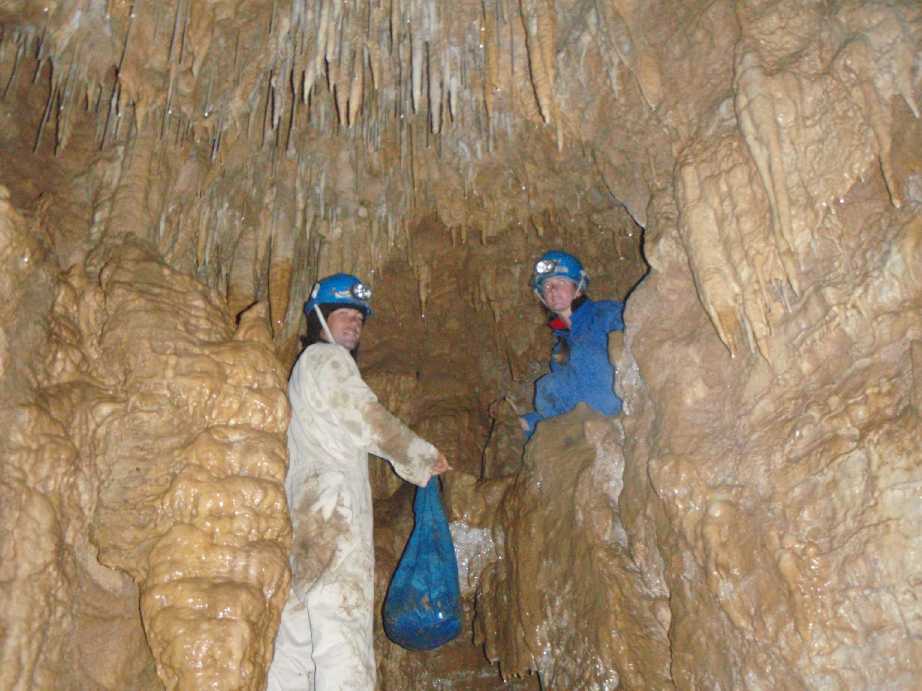
Outfitted with long underwear, fleece, woolen caps, overalls, and miners helmets, we lept the barbed fence. We stopped in a depression, near a blackberry bush. We were here! But what was here? We expected to walk around in a cave for a few minutes, ooh and ahh some stalagtites, and jump back in the van. But then what was all this gear for? Dan whipped out a laminated sketch, handed us another copy. It was important, he reminded us, that we all had maps—incase he didn't make it. The sketch was a tangled and confusing network of dotted and solid lines. There was some text too, names like "The Birth Canal," and "The Long Squeeze." Dan gestured toward the blackbery bush, and told us to climb in. At the base of the bush was a dark muddy crack leading 12 feet straight down, about 10" wide. I looked at Marc,a big strapping young buck of 6'3 with broad strong shoulders and size 14 sneakers. I wished him luck, and we slithered in. You won't find any tourists down here, Dan promised.

After an hour of twisting and turning down into the cave, Marc was thinking that this was the worst surf-trip he'd never even dreamed of. At least 100 feet underground, he was deep in "The Long Squeeze," about 20 feet into the tube with a twisting 15' remaining before it opened up again. He was also stripped down to his underwear. Dan figured undressing would help to minimise his size and give maximum freedom of movement. Marc was covered in mud, eye wide with his constricted breath misting before him as Dan coached him through the contortions necessary to pass "just a bit of a kink." Helpful phrases like "bend your spine over backwards!" and "try not to breath!" echoed down the tunnels.

After that, things opened up and we joined an underground river. The rock formations were fantastic: white collumns, brown spires, flowstone, waterfalls, cliffs and beaches, all underground. When we emerged hours later, exhausted, bruised and sore, we were deep in a forest and it was pouring rain. A short hike brought us back to the van, where Dan appraised our sorry state and decided that about 3 hours of rock climbing was just what we needed.

The rest of that day was a blur, but our brains once again began recording memory around 6 a.m the next morning, as Dan guided the van towards the mighty Tongariro River. It'd been raining all night, so he figured this was a good time for "a quick river float," which he thought should wake us up effectively. Dan doesn't believe in coffee. We piled in rafts and were swept off down the muddy, swolen river. 2 hours and 60 rapids later, we were fully awake as we loaded the raft for the drive back to the van. Since we were already quite wet, there was a nearby underground river network Dan thought we should explore. We squeezed and splashed through a new cave, keeping the glow worms company. Our guide noticed we were exhausted to the point of being delusional, so, having no map of this cave, he took the opportunity to pretend we were lost, dropping comments like "is it just me or does the water look higher to you, mate?"

The following morning when Dan rousted us, it was pitch black. He told us we were going for a 20 km tramp over some volcanoes, so dress warm. Steam filtered out of the black and broken ground as we moved across the summit and down the backside of the volcanic ridge. Well down the backside, Dan turned around to "pop back over," grab the van, and pick us up on the other side. When we finally stumbled into the parking lot, Dan was bouncing with impatience for the next adventure. Since we were hot, sweaty, and stinky, we drove back to the Tongariro River, grabbed a coil of line and we jumped back in for a bit of canyoning. The short definition of canyoning is traveling down a section of river, on foot and in the water, that has too many waterfalls for a raft or kayak to run. I only hazily remember two things from that afternoon. The first is Dan telling us to jump in the river, float through this next set of rapids, but be careful to stop at the end as there is a 60 foot waterfall just around the corner. The second is when we jumped off a cliff which was high enough that when Marc didn't clench his lips on impact, the water in his mouth split his upper lip away from his gums. Back at the van, Dan peered inside his mouth, decided that the doctors probably wouldn't be able to stitch him up anyway, and off we went.


We've only touched on about half of the activities we did with Dan—but that's because we only remember half. Mostly we recall the mornings, before the daily exhaustion began to take its toll. Our firm belief is that the only reason we survived is because Dan had to go back to work on Monday. To recuperate, we left Dan behind and drove to the beach. The culmination of our search for surf was at Shipwreck Bay. With the help of two wooden boards and an hour's careful driving and pushing, we got our sedan out through the tide pools to the surf. The double overhead waves were smoking around the point and they just kept on going. On the biggest day, we marked out on the beach how long our rides were. We used the car's odometer to measure the distances, and found that we were getting waves over a mile long. After our fourth session that day, we felt like we were back with Daniel—exhaustedly euphoric.

By the time the swell was spent, it was time for poor Marc to move on. Originally he'd planned to continue to Austrailia, Indonesia, and Fiji in his search for waves. He'd arrived in NZ in top physical condition, ready for anything, but now he was sporting two injured knees, a split lip, and a bad gash to his hand. He was exhausted and having a hard time with side effects from antibiotics he was taking for his wounds. Marc flew home to recuperate, with plans to pick up his trip in a few months when he's recovered.


Sorry this has dragged on so long, but even so we've had to skip over so much: another canyoning trip, going deep inside a cave network of WWII gun turrets. A crazy drive out in the boonies to a strange hospital for Marc's hand. Mountain biking, two days of perfect surf at the Whangamata Bar. A long drive and all night vigil on Orca for the Japanese Tsunami. Lots of hot springs, museums. Two nights with Cassandra, when we speared enough fish and gathered enough abalone for a feast for ten, later cooked by Mike, a chef at a five star resort.